
White Sourdough
**Recipe from my favorite food blog, alexandracooks.com. This is the most foolproof sourdough bread I have tried. She (Alexandra Cooks) has better instructions than me so if you need more help, her blog is a great resource for this recipe (she did make the recipe!) and for a lot more bread recipes. I still have seasons when it doesn’t rise as well or when it gets a little gummy in the inside, but it seems like once I go back to the basics, I can get it just right again. This bread tastes better than a restaurant – it is so delicious!!
White Sourdough Boule
Ingredients
- 50 grams sourdough starter
- 375 grams (1 ½ cup + 1 tablespoon) warm water
- 500 grams (4 cups + 2 tablespoons) bread flour (I like using Breadtopia organic select bread flour because some bran and germ is left intact, but they also make an organic white bread flour that bakes really well, it just doesn’t have the bran and germ. Both work in this recipe. The white may rise a little more and be a little less dense, but the select still rises well and isn’t dense like a wheat bread.)
- 9 grams (1 ½ teaspoons) course sea salt
Directions
Activate Starter: First discard about 1/4 of your starter. You will want to discard more if you have left your starter too long in the fridge or if you need some for a discard recipe. I always keep at least 200-300 grams of starter and often, even more than that. After discarding a little starter, add equal parts bread flour and non-chlorinated water. I add about 45 grams of each (lately, I’ve been adding 75 grams of each so I can have more starter on hand). Let starter sit on counter at room temperature and when it nearly doubles and is bubbly, it should be activated. This should take about 4-6 hours. Mine often doesn’t double all the way, but I can tell it’s ready because it’s really bubbly. Drop a little bit in a glass of non-chlorinated water and if it floats, then you know it is ready. If it doesn’t float, discard a little bit of starter and then add equal parts flour and water again and let rise again for about 1-3 hours, checking after an hour to see if it floats. When it floats, it is ready.
Mix starter and water in large bowl or straight sided vessel with a fork.
Add flour, then salt, mix with a rubber spatula or large spoon to form a rough dough. You may need to work it with your hands a little bit to get all of it together.
Cover bowl with a tea towel. Let rest for 1 hour.
*Don’t forget to Replenish Starter by adding back 45 grams (or more, depending on how much starter you keep) each of water and flour and put it back in fridge. I use or discard and feed my starter at least once per week and that seems to keep it from getting too much “hooch” on it and it still activates pretty quickly.*
After one hour of your dough resting, dust hands with flour and perform 3-4 stretch and folds in 15-30 minute intervals. I typically just reach my floured hand in the bowl and pull up on one side of the dough and then lay it back down on the dough ball, then turn the bowl, pull up on another side of the dough and place it back down on top of the dough ball, and repeat until I’ve pulled all sides of the dough and a ball is formed. I don’t even take the dough fully out of the bowl. Also, 15 minute intervals works fine for this recipe.
After the last stretch and fold, the dough should be formed into a nice dough ball. Keep it in your vessel or bowl and let rise overnight, or 8-10 hours.
Dough should almost double and still jiggle and bubble when ready.
After the long rise, place dough onto floured surface, gently stretch out into a rectangle trying not to burst the bubbles, then dimple the dough with your fingertips, and last, fold gently like an envelope (again, trying not to burst the bubbles) until full circle, and is shaped into the desired shape, and let rest 5-10 minutes.
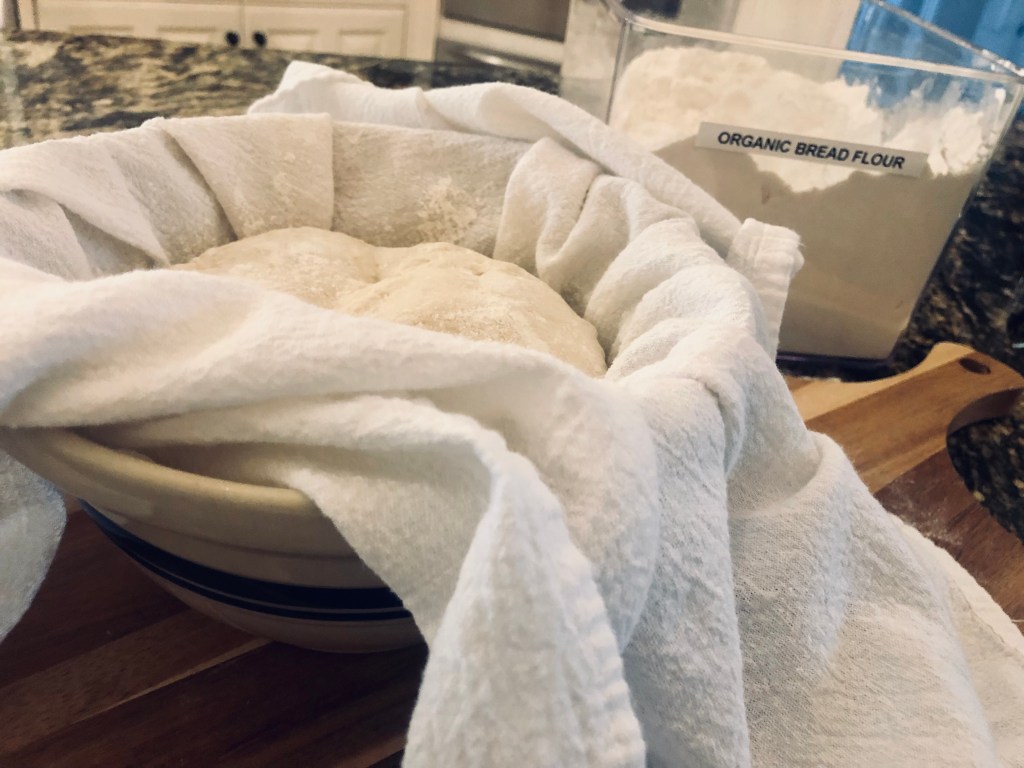
Line proofing bowl (or banneton) with a sackcloth and then dust with flour. If your banneton has ridges that you want to see in your finished bread, you can just dust that with flour and you don’t need to use your sackcloth.
Flip dough and pull sides up and on top of your dough and shape again into desired shape, and then place in floured bowl, seam side up.
Cover and refrigerate for 1 hour to set, or up to 48 hours.
Remove from fridge and let sit while oven preheats.
Preheat oven to 450 degrees.
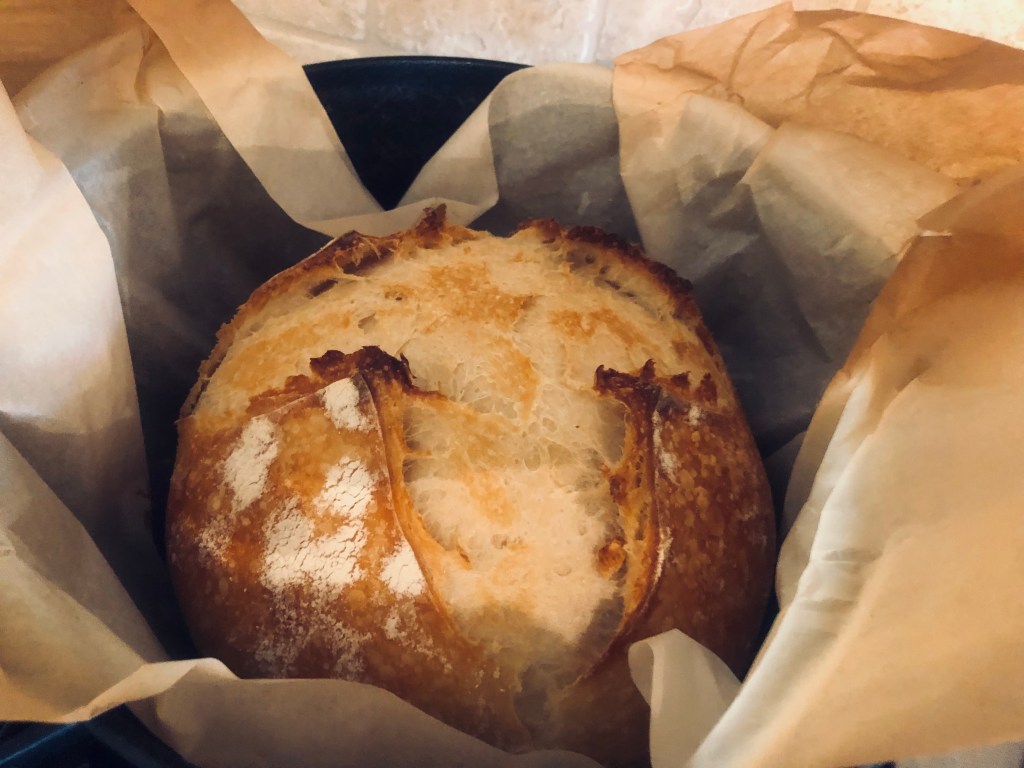
Place parchment paper over the dough and invert dough onto parchment, place in dutch oven, score the bread.
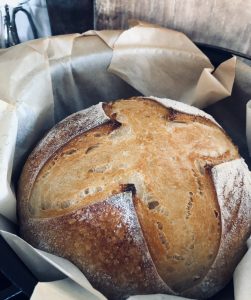
Place on center rack, bake 30 minutes covered, 20-30 minutes uncovered.
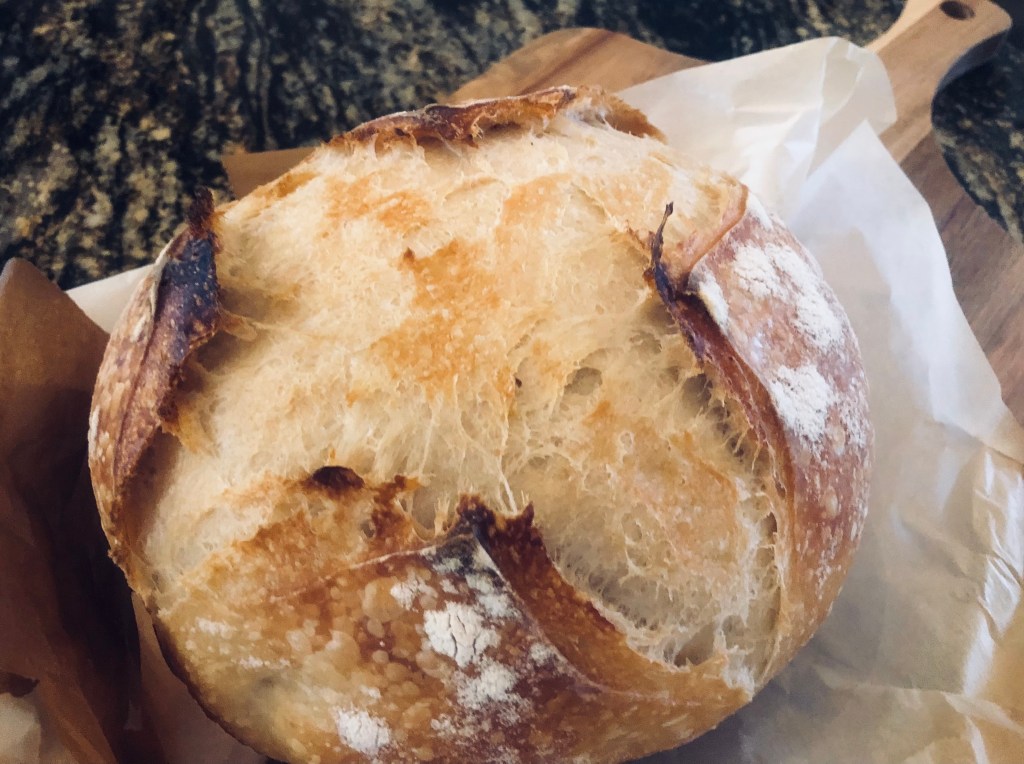
Let cool at least 1 hour. Lately, I’ve been letting mine rest 6 hours. I have found that the cooler it is, the better it slices.
Enjoy!
 Wholly Fed
Leave a comment